We Won Space Rover Cup 2026: Three Missions with One Rover, TR-2
 つくまろ君
On October 24, 2026, TSUKUBA ROVER TEAM, a student rover team from Tsukuba, Japan, won Space Rover Cup 2026 at Tokyo University of Information Sciences in Chiba, Japan, taking first place out of eight teams with our second rover, TR-2. It is our second title this year, following our win in the Entry Division of the Tottori Rover Challenge 2026 in March. Here is a look back at a competition where one rover took on three very different missions: aiming, stacking and carrying.
What Is Space Rover Cup 2026?
Space Rover Cup 2026 is a student-led engineering competition organized by the Intelligent Robotics Lab at Tokyo University of Information Sciences. It took place on the university's second athletic field in Wakaba Ward, Chiba City, where CanSat-style model satellites and large planetary exploration rovers compete on the ground.
What matters is not speed, but how reliably a rover can complete its tasks. There are three missions — Darts, Unmanned Construction and Sample Retrieval — each with a 15-minute time limit and a maximum raw score of 450 points. The final score is the sum of the three raw scores multiplied by a weight multiplier and a control multiplier. The lighter the rover, the larger the weight multiplier; the control multiplier is 1.2 for fully autonomous operation and 1.0 for remote control. So the rules reward not only mission performance, but also a light and autonomous design.
Our Second Rover, TR-2
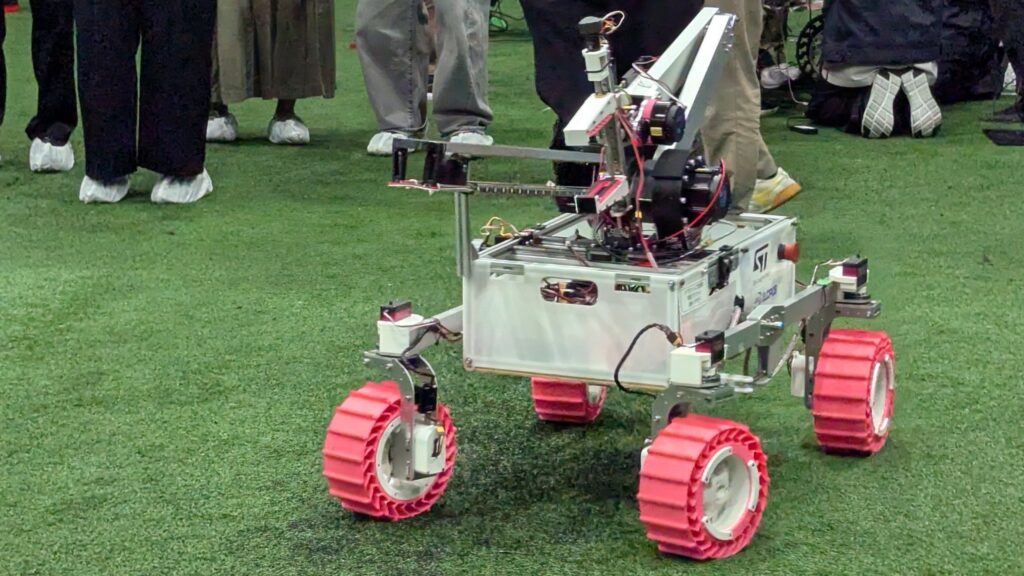
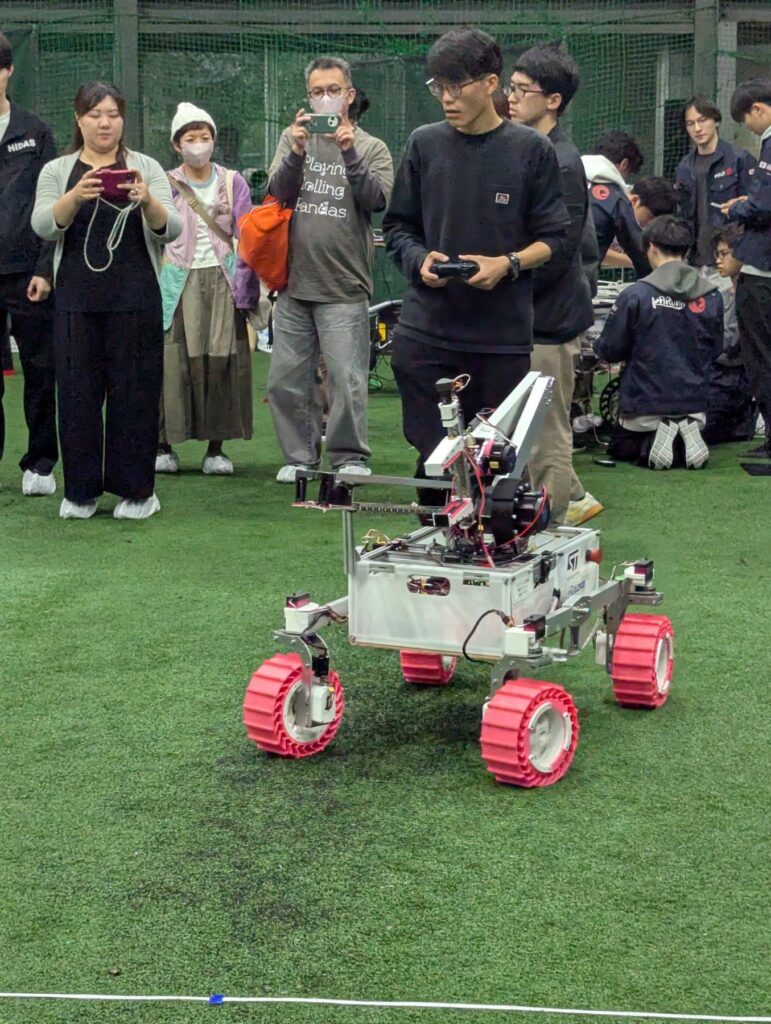
TR-2 is our second rover, developed with an eye on the University Rover Challenge (URC) 2027, the world's premier student rover competition, held in the Utah desert in the United States. It keeps the four-wheel drive and four-wheel independent steering of our first rover, TR-1, with the steering servos upgraded to high-torque 160 kgf units. At the competition, TR-2 weighed about 37 kg.
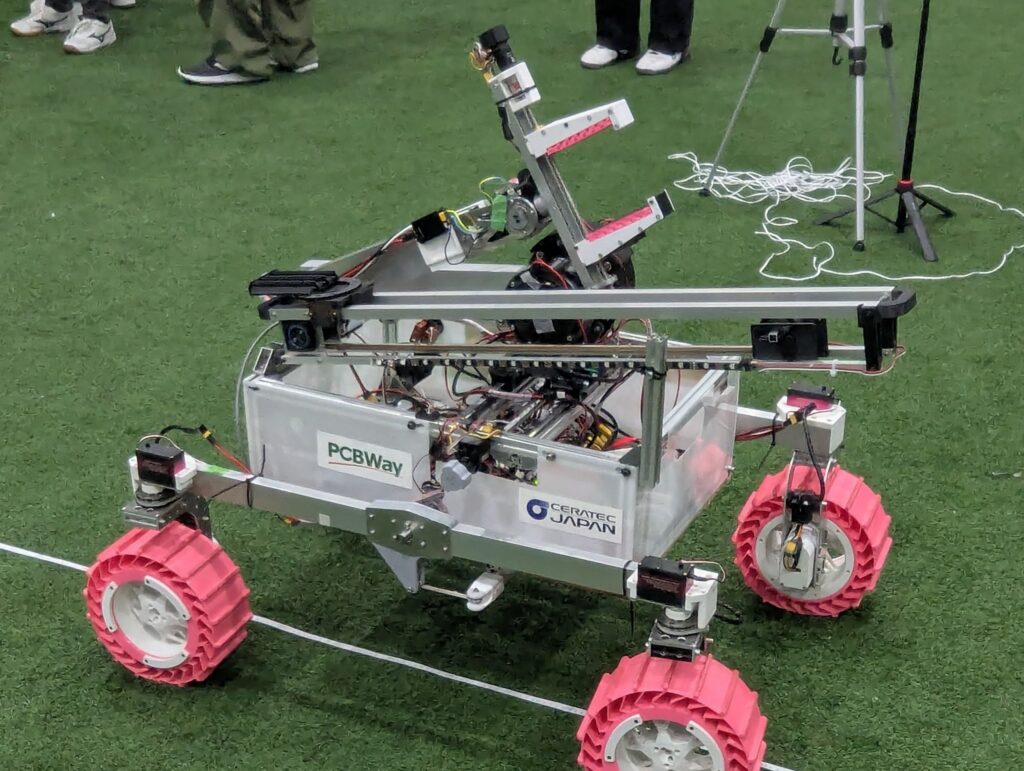
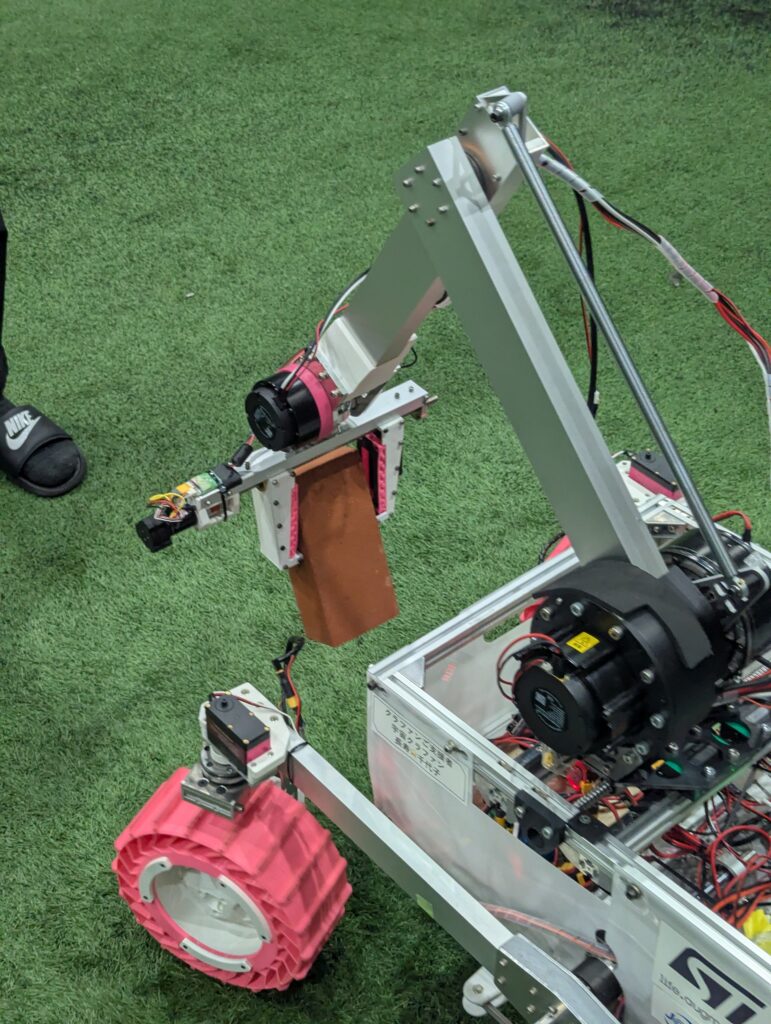
The biggest change is the arm. We increased the joint torque and replaced the yaw rotation axis with a linear motion mechanism so the arm can move in parallel. The joints use 1:9 cycloidal reducers that our team designed and built ourselves. Space Rover Cup 2026 was TR-2's first competition.
ROVER
TR-2: Our Second Rover
Our second rover, built with URC2027 in mind and winner of Space Rover Cup 2026. (Page in Japanese)
Learn more →
Aiming: Darts
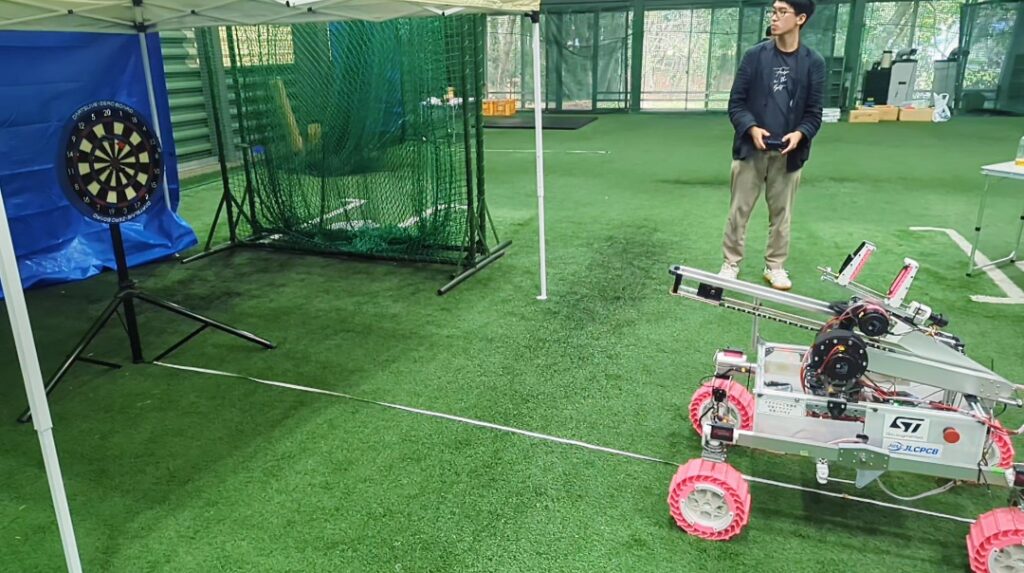
In Darts, a rover throws up to three darts. The score of each hit is multiplied by the throwing distance (0.5 to 2.5 m), so accurate throws from far away earn the most points.
TR-2 aimed at the board from 2.5 m, the farthest distance allowed, and scored 77.50 points in Darts. It was a difficult mission, but this was the top Darts score of the competition.
Stacking: Unmanned Construction
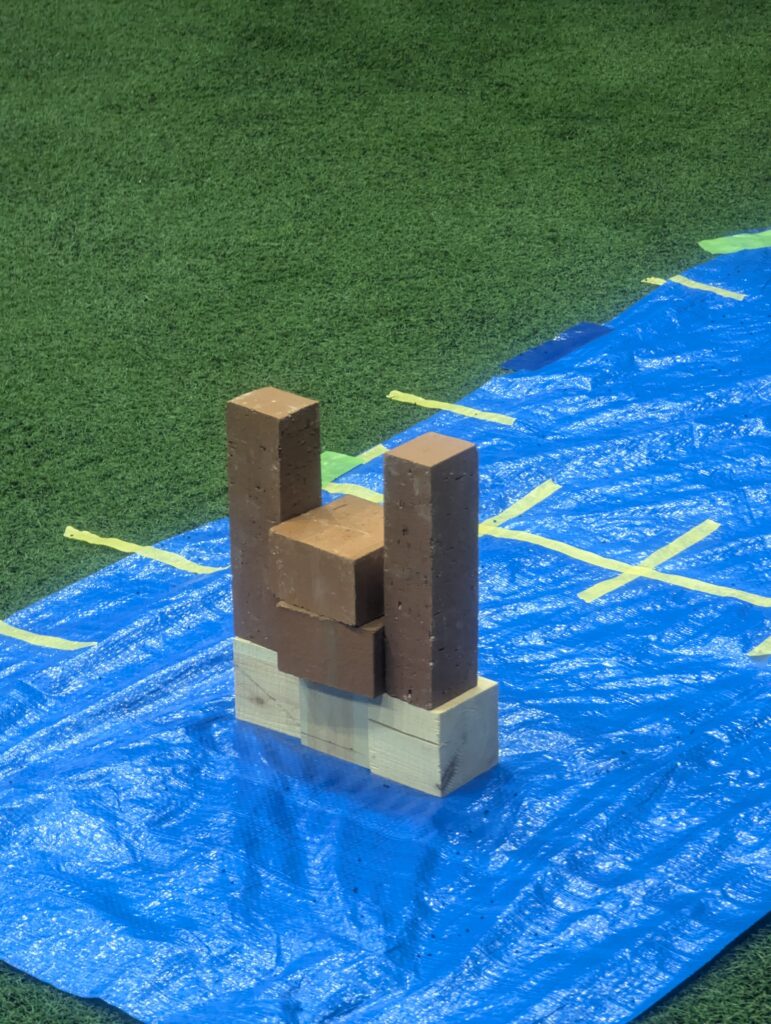
In Unmanned Construction, a rover carries wooden blocks and bricks and stacks them to build a wall. Points are given for each piece placed and stacked, and for the finish of the wall.
TR-2 picked up the materials one by one with its arm, carried them to the construction area and stacked them. Besides the points for placing and stacking, it met all of the finishing conditions — a flush wall face, three layers, and standing on its own for 10 seconds — and earned a perfect 450 points.
Carrying: Sample Retrieval
In Sample Retrieval, a rover carries natural stones and lava rocks from the field back to the collection area at the start, and is scored on their total weight. Collecting 10 kg earns a perfect score.
TR-2 repeatedly picked up stones with its arm, carried them and set them down, bringing four stones into the collection area within the time limit. Their total weight reached 10 kg, for another perfect 450 points.
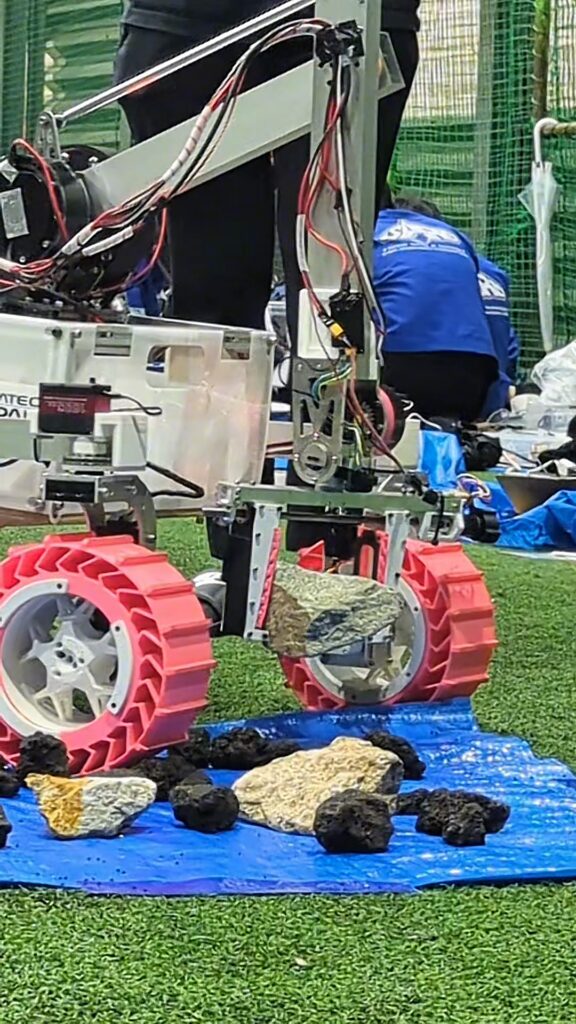
We believe our upgraded arm, with stronger joints and parallel motion, was key to earning perfect scores in the two missions that required grabbing and carrying heavy objects.
First Place Out of Eight Teams
TR-2's raw scores were 77.50 in Darts, 450 in Unmanned Construction and 450 in Sample Retrieval, for a total of 977.50 points. Multiplied by a weight multiplier of 1.2722 for our rover's weight, minus a 10-point penalty, our final score was 1,233.60 points, putting us first out of eight teams.
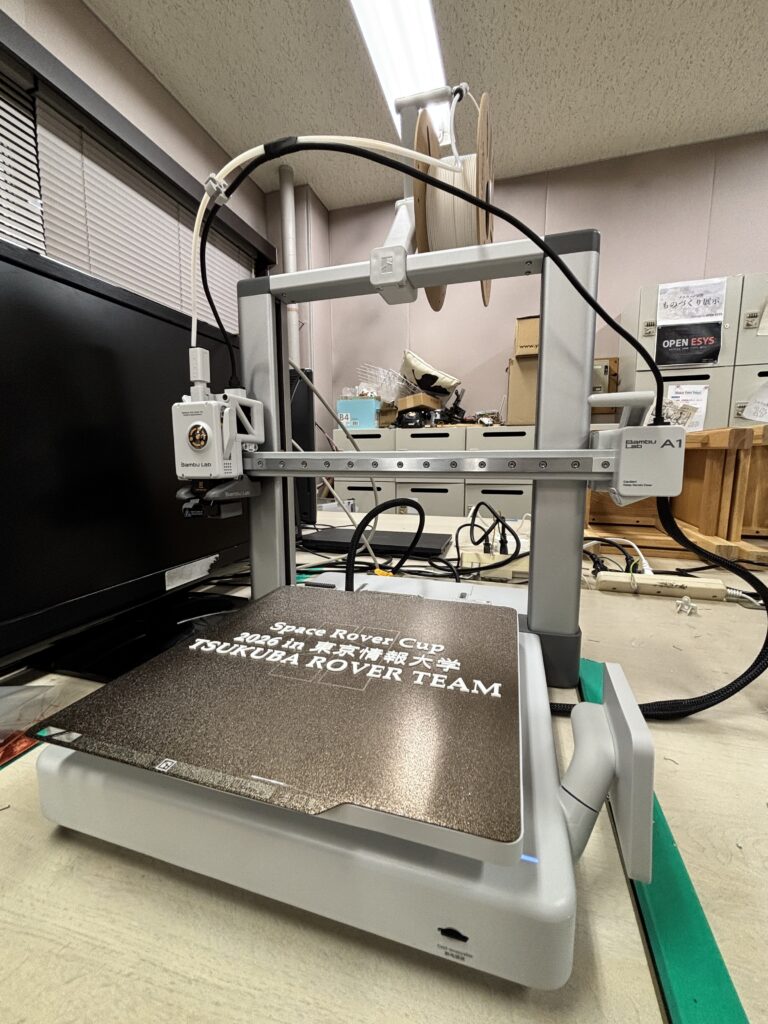
As an extra prize, we received a Bambu Lab A1 3D printer, with the competition name and our team name on its build plate. We use 3D printers for everything from prototyping parts to repairs during competitions, so it is a very welcome addition.
A Last-Minute Build and a Mid-Run Problem
The win may make it look like everything went smoothly, but TR-2 was ready just in time. Right before the competition, we completely redesigned the electronics boards and switched the arm's control method.
We also had a problem during the competition. In the middle of Sample Retrieval, the hand opened too far and got stuck. We had not had time to install the limit switch that would prevent this. We stopped, reset the hand by hand and continued, but this counted as an adjustment during the run, so we received a 10-point penalty.
Even so, there were no major failures that forced us to stop, and one rover made it through all three missions.
Videos and Event Report
You can watch the competition in the organizer's livestream archive (in Japanese).
DARTSLIVE, a sponsor of the competition, also featured our win in their event report (in Japanese).

DARTSLIVE NEWS
Space Rover Cup 2026 Event Report
DARTSLIVE official website news (in Japanese)
Read the article →
What's Next
This win showed that TR-2's upgraded arm works well for grabbing and carrying heavy objects. On the other hand, we competed under remote control this time, so our control multiplier was 1.0. Autonomy is the area we most want to improve.
For the hand, we are adding a limit switch and switching to metal fingertips. We are also working on localization, dust-proofing and more stable communications. Our goals for 2027 are a top finish in the Expert Division of the Tottori Rover Challenge 2027 and a place in the URC2027 finals. We will keep developing a rover that can compete not only in Japan but on the world stage.
Thank You
We would like to sincerely thank the Intelligent Robotics Lab at Tokyo University of Information Sciences for organizing and running the competition, and everyone who supported it.
Our activities are supported by STMicroelectronics, PCBWay, JLCPCB and Ceratec Japan, and by everyone who backed us through crowdfunding. The microcontrollers that control TR-2 are also from STMicroelectronics. Thank you all once again.
COMPETITION
Space Rover Cup 2026
Competition overview, results of the three missions and the score table. (Page in Japanese)
View the competition page →
About TSUKUBA ROVER TEAM
TSUKUBA ROVER TEAM is a planetary exploration rover team founded in 2025 in Tsukuba, Ibaraki, Japan. Our members are mainly students of the University of Tsukuba and Osaka Institute of Technology. Mechanism design takes place in Osaka, and assembly and testing in Tsukuba. The team works across four areas: mechanical, electrical, software and science.
In 2026, we won the Entry Division of the Tottori Rover Challenge 2026 and Space Rover Cup 2026, and we have registered for the University Rover Challenge 2027.
ANNOUNCEMENT
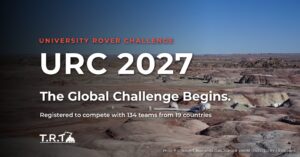
TSUKUBA ROVER TEAM Registers for University Rover Challenge 2027
We have registered for URC2027, joining a record 134 teams from 19 countries
Read the article →
We are looking for sponsors and partners in Japan and overseas to help us compete at URC2027. If you are interested in supporting us, please contact us through our website or social media.
Follow Us
Website: https://tsukuba-rover-team.com/
Instagram: https://www.instagram.com/tsukuba_rover/
X: https://x.com/TsukubaRover
Facebook: https://www.facebook.com/tsukubarover
YouTube: https://www.youtube.com/@TsukubaRoverTeam
Threads: https://www.threads.com/@tsukuba_rover